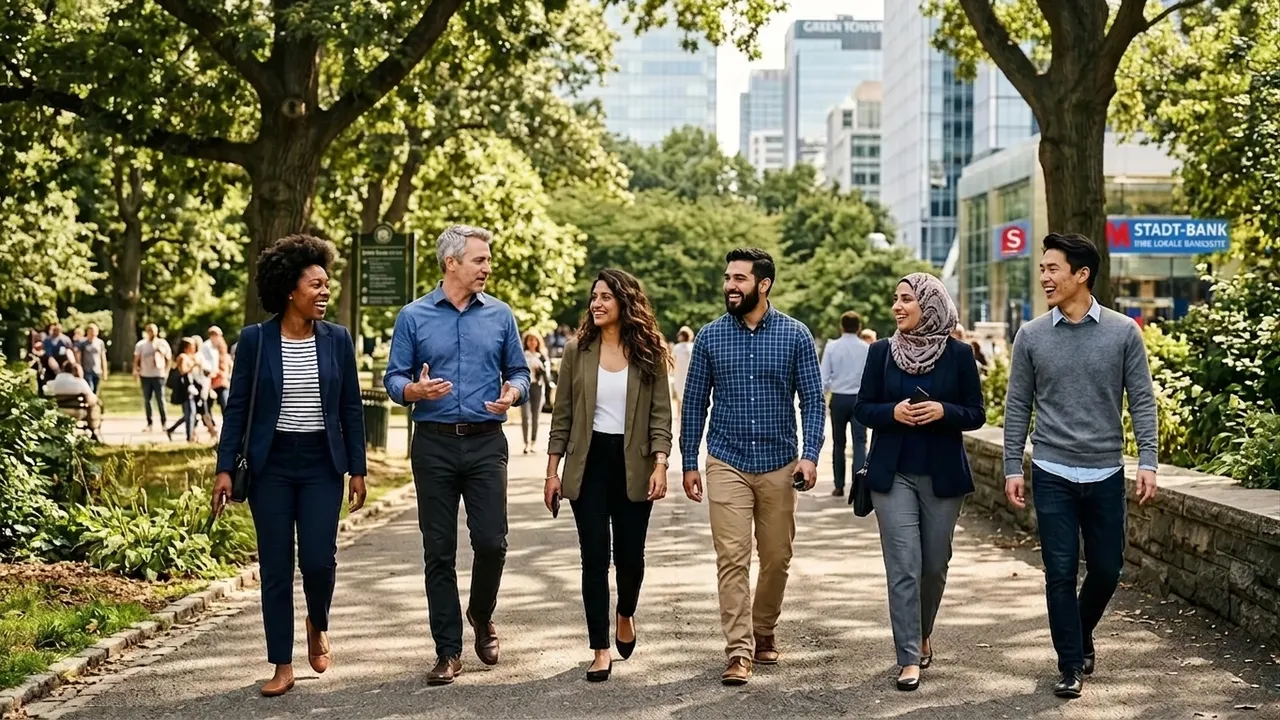
Not every team activity needs a measurable output. The team walk is an exception to the efficiency logic of everyday office life – and precisely because of that, it's so effective. Get outside, together, without an agenda.
What happens when a team simply starts walking?
Sitting side by side instead of facing each other fundamentally changes conversations. People talk more openly, more personally, and with less status-consciousness while walking. The team walk is thus not just movement, but an informal communication format – one that needs no facilitation and yet moves things that get stuck in meetings. Some teams find that pent-up conflicts or misunderstandings are easier to resolve after a shared walk.
How do regular walks become a genuine team habit?
Twice a month, 30 minutes, a fixed weekday: that's enough to establish a habit, and little enough not to feel like a burden. It's important not to overload the walk with an agenda. No brainstorming, no meeting minutes, no reflection task – just walking. What gets discussed along the way is up to the people themselves. A good complement is the best practice Lunch Walk: Walking together instead of sitting.
How do you put the measure in place?
- 1Set a fixed weekday and a fixed time in the lunch break for the 20-minute walk.
- 2Plan one or two circular routes of about 20 minutes from the company entrance and set a meeting point.
- 3Appoint one person to lead the walk, so that pace and return time are reliable.
- 4Send out the invitation with weekday, time and meeting point, and set up a recurring calendar entry for 12 weeks.
- 5Explain the idea: 20 minutes of fresh air, movement and conversation together instead of being alone at the desk.
- 6Ask for a short reply on who will join the first date, and remind people on the day itself.
- 7Remind people of the shared walk every week, shortly before the date.
- 8Start on time at the meeting point and walk the route together, so that everyone is back within the lunch break.
- 9Keep the hurdle low: no sign-up requirement, new faces may join every week.
- 10Note how many people joined on average per week.
- 11Ask the team how the walk was received and whether the lunch break became more restful as a result.
- 12Decide together whether the team walk continues as a permanent weekly ritual.
What do you need for it?
- Effort
- under 30 min
- Cost
- Free
- Duration
- Weekly
- Setup
- 5 min
- ✓ Free
- ✓ Inclusive
- ✓ Regular
- ✓ Outdoors
Tax and health insurance: what is possible
Employer health benefits can be tax-free under § 3 no. 34 of the German Income Tax Act (EStG) up to €600 per employee per year — if they are provided in addition to the salary already owed and are either certified (§ 20 SGB V) or implemented within the company's health promotion process. Gym memberships and corporate fitness are not covered. For ZPP-certified courses (e.g. from Upfit), German statutory health insurers can reimburse all or part of the course fee to their insured members — then only the amount exceeding that reimbursement is tax-free. Projects within the company can be funded under § 20b SGB V, with no entitlement. Only your tax adviser can confirm the tax exemption.
How it works in EasyWHP
This Best Practice in EasyWHP: adopt it, adapt it, measure the effect
Once adopted, the measure is ready in EasyWHP — with instructions, an invitation and surveys before and after. You adapt what fits your company and see at the end what it achieved.
Screenshots with demo data, no real people.
Adopt it for your company
Register for free — and the measure is ready to go in your cockpit: invitation, feedback survey and appointment are already set up. First cycle, first numbers for the boss.
Try EasyWHP for freeRather take a look first? To the live demo →
Contributes to
Measure the impact with
Action field
Physical Activity →A fitting occasion
- International Day of Movement (May 10): Company Movement Day
Related Best Practices
Not sure where to start? Self-check in approx. 7 minutes →