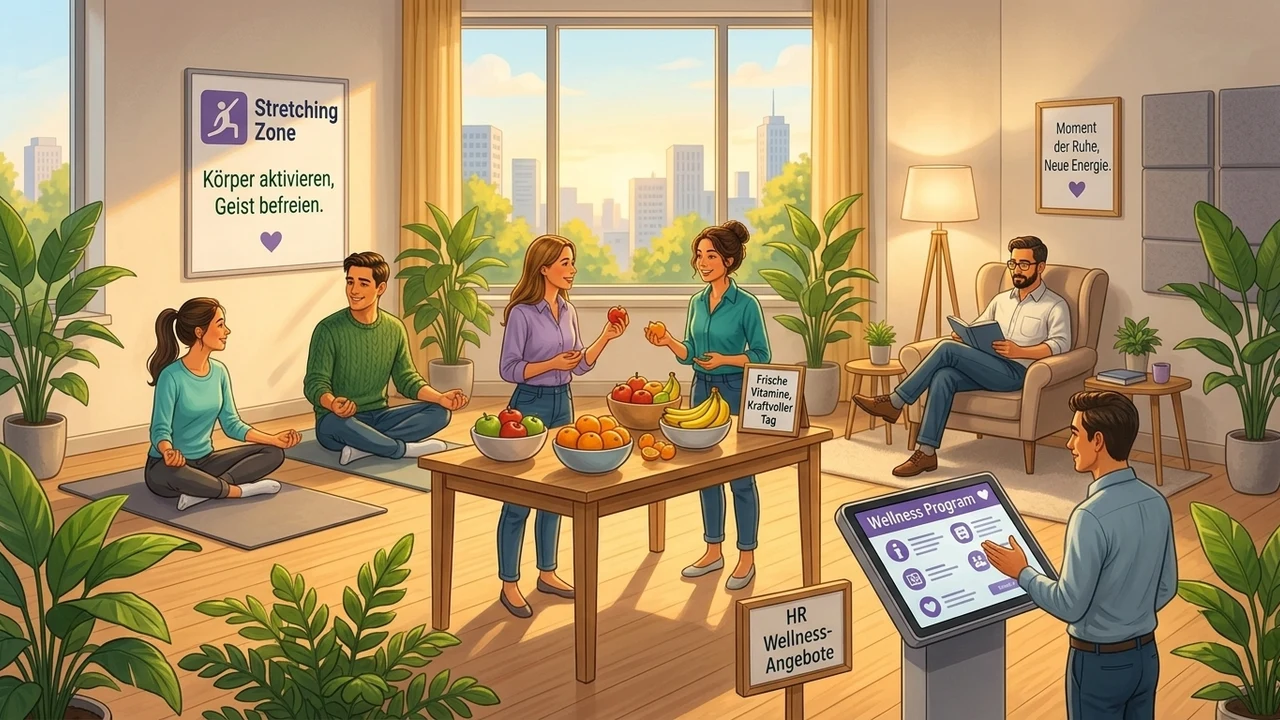
WHP Focus Areas & Funding
What are the core areas of workplace health promotion (WHP) — and how is it subsidized?
Note: based on German law. Workplace health promotion (WHP) covers four focus areas: exercise, nutrition, mental health, and addiction prevention. Statutory health insurers can fund measures as a project under Sec. 20b SGB V, with no entitlement for the company. Separately, employer health benefits are tax-free up to €600 per employee/year under Sec. 3 No. 34 EStG — a tax allowance, not a payout; only your tax advisor can confirm the tax exemption.
The four focus areas of WHP
| Focus Area | Example Measures |
|---|---|
| Exercise | Sports programs, company runs, back training |
| Nutrition | Healthy cafeteria food, fruit baskets, nutrition workshops |
| Mental Health | Stress management, resilience training, mindfulness courses |
| Addiction Prevention | Education, counseling services |
How does workplace health promotion differ from occupational safety?
Workplace health promotion (WHP) covers all measures that go beyond the statutory minimum requirements of occupational safety and actively promote employee health. Unlike occupational safety and BEM (workplace reintegration), WHP is entirely voluntary under German law — but eligible for funding from statutory health insurers and tax-advantaged.
What belongs to the four classic focus areas?
Exercise includes sports programs, company runs, or back training to counter the most common musculoskeletal complaints. Nutrition ranges from healthy cafeteria food to fruit baskets to nutrition workshops. Mental health — increasingly central given rising sickness absence due to mental disorders (TK Health Report 2025: +159% since 2006, age-adjusted) — covers stress management, resilience training, and mindfulness offerings. Addiction prevention rounds out the spectrum with education and counseling services. Important for tax purposes: cafeteria food and fruit baskets are not eligible under Sec. 3 No. 34 EStG (German tax law) — nutrition workshops as part of the health promotion process, for example, can be tax-free.
How is WHP funded — and what does the tax allowance have to do with it?
Under Sec. 20b SGB V, German statutory health insurers have the task of supporting WHP. They fund projects — a single measure, a health day for a few thousand euros, or an annual budget (e.g. €5,000), often combined with free consulting. There is no entitlement for the company and no fixed amount per employee. Separately, employers can provide health benefits tax-free up to €600 per employee per year under Sec. 3 No. 34 EStG, on top of the wages already owed. This €600 is a tax allowance — an upper limit, not a target and not a payout. Eligible are ZPP-certified prevention courses and measures within the workplace health promotion process; only your tax advisor can confirm the tax exemption.
Key takeaways
- Note: reflects German law. Four focus areas: exercise, nutrition, mental health, addiction prevention.
- WHP is voluntary — health insurers can fund projects under Sec. 20b SGB V, and under Sec. 3 No. 34 EStG, employer health benefits can be tax-free up to €600 per employee per year.
- The €600 is a tax allowance — a cap, not a target and not a payout; only your tax advisor can confirm the tax exemption.
- ZPP certificates exist only for prevention courses under Sec. 20 SGB V — measures in the WHP process under Sec. 20b SGB V need no certification.
Frequently asked questions
Does every WHP measure have to cover all four focus areas?+
No. Many companies start with one or two focus areas that fit their workforce and expand step by step. What matters is a needs-based selection rather than scattershot activity in every direction.
Are all WHP measures automatically tax-free?+
No — under German law, Sec. 3 No. 34 EStG requires the measure to meet the requirements of Secs. 20 and 20b SGB V. There are two routes: ZPP-certified prevention courses, or measures implemented within the workplace health promotion process — with a needs analysis and employee involvement; no certification is provided for these measures. Isolated one-off activities without a certificate and without a process do not qualify. Only your tax advisor can confirm the tax exemption in the individual case.
Can we use statutory health insurance funding and tax exemption at the same time?+
Yes, both can exist side by side under German law — they are two separate routes. The health insurer funds a WHP project with an agreed sum, with no entitlement. Separately, employer benefits can be tax-free under Sec. 3 No. 34 EStG. If the insurer has already subsidized a course, only the part the employer pays on top is tax-free. Only your tax advisor can confirm the tax exemption.
Plan WHP measures to be funding-eligible
EasyWHP guides you through the workplace health promotion process and documents it — the basis for your conversations with your health insurer and your tax advisor.
Sources
- Sec. 20b SGB V — Workplace Health Promotion ↗
- Sec. 3 No. 34 EStG — Tax-Free Employer Benefits ↗
- TK Health Report 2025 — sickness absence due to mental disorders +159% since 2006 (age-adjusted) ↗
Last updated: 2026-07-06. Not legal or tax advice — have your specific case reviewed by a professional.