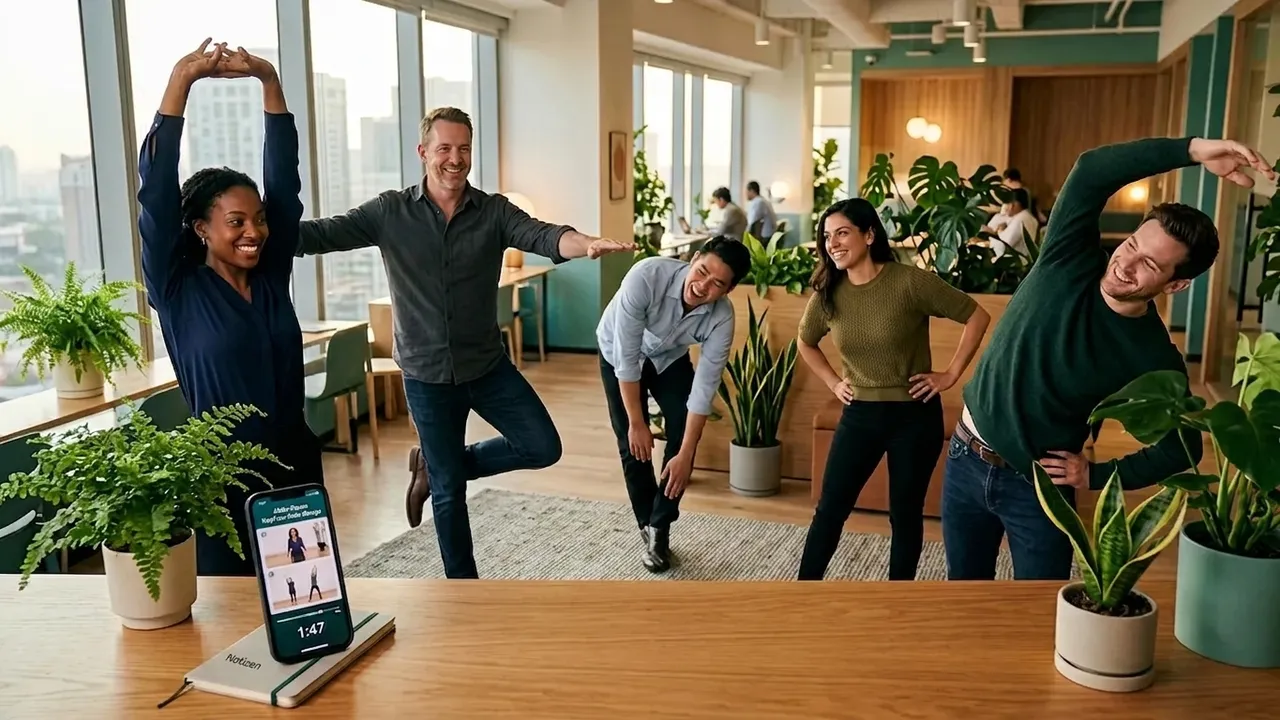
The longest stretches of sitting don't come from laziness but from concentration. Deep in a task, people forget their body, the clock, and their back – until the afternoon slump hits. The micro-break challenge intervenes exactly at this point: it turns standing up into a collective act, removing the hurdle in the process.
Why does a short break achieve more than a long walk?
The nervous system doesn't need an hour of movement to get out of stress mode – it needs interruptions. Just 2–3 minutes of standing, stretching, or breathing helps to briefly step out of stress mode and ramp concentration back up afterward. Standing up briefly every hour doesn't cost time – it wins back focus. The challenge gives the effect a name and a framework: three weeks, team ranking, daily check-ins.
How does the competition become a habit?
The trick with micro-break challenges is the social mirror: when I see that three colleagues are also marking a break on the hourly tracker, standing up feels normal. After three weeks, the ranking is no longer needed – the body signals it on its own. A good complement is the best practice Micro-breaks via reminder: Movement that reminds itself.
How do you put the measure in place?
- 1Announce the challenge by email: "21 days, 3 minutes – are you in?"
- 2Share the daily exercise (email, chat, or poster)
- 3Tracking: participants check off each day (downloadable tracking sheet)
- 4Share a weekly interim summary
- 5Day 21: celebrate the result, gather feedback
What do you need for it?
- Effort
- under 30 min
- Cost
- Free
- Setup
- 15 min
- ✓ Free
- ✓ Only 3 minutes a day
- ✓ Habit building
- ✓ Doable at the workplace
Tax and health insurance: what is possible
Employer health benefits can be tax-free under § 3 no. 34 of the German Income Tax Act (EStG) up to €600 per employee per year — if they are provided in addition to the salary already owed and are either certified (§ 20 SGB V) or implemented within the company's health promotion process. Gym memberships and corporate fitness are not covered. For ZPP-certified courses (e.g. from Upfit), German statutory health insurers can reimburse all or part of the course fee to their insured members — then only the amount exceeding that reimbursement is tax-free. Projects within the company can be funded under § 20b SGB V, with no entitlement. Only your tax adviser can confirm the tax exemption.
How it works in EasyWHP
This Best Practice in EasyWHP: adopt it, adapt it, measure the effect
Once adopted, the measure is ready in EasyWHP — with instructions, an invitation and surveys before and after. You adapt what fits your company and see at the end what it achieved.
Screenshots with demo data, no real people.
Adopt it for your company
Register for free — and the measure is ready to go in your cockpit: invitation, feedback survey and appointment are already set up. First cycle, first numbers for the boss.
Try EasyWHP for freeRather take a look first? To the live demo →
Contributes to
Measure the impact with
Action field
Physical Activity →A fitting occasion
- Back Health Day
Related Best Practices
Not sure where to start? Self-check in approx. 7 minutes →