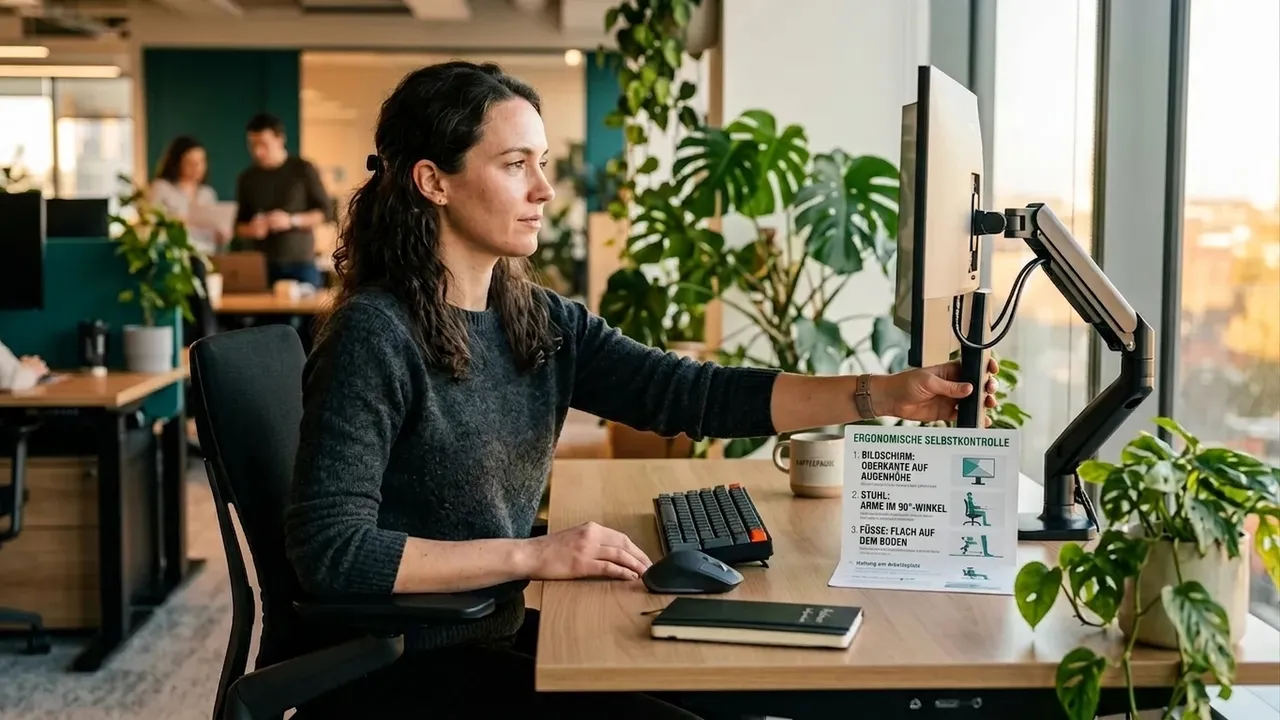
10-Minute Ergonomics Self-Check
A building block close to the occupational safety obligation: a structured ergonomics self-check uncovers incorrect settings – an ideal complement to risk assessments and back-health prevention.
Why is the most expensive chair useless if it's set up wrong?
Many companies invest in good furniture and overlook the fact that its effectiveness depends on how it's adjusted. A screen edge set too low, an incorrect seat height, an awkward mouse position – each harmless on its own, but together they're fertile ground for chronic complaints. Experience shows that a large share of the workforce has at least one critical issue they're not even aware of.
Why does self-checking beat a one-off consultation?
A self-check based on clear criteria has two advantages: it reaches everyone at once, and it trains the eye. Once someone has understood what matters, they'll correct their own setup in the future too – for example after a move or when working from home. A one-time measure thus becomes lasting self-sufficiency.
Why is the self-check the ideal kickoff for a back-health campaign?
The self-check works perfectly as a first step: it makes the problem visible and creates motivation for what follows – such as short movement breaks or desk yoga. Scheduling it around Back Health Day concentrates attention and impact. Cost: virtually none, apart from ten focused minutes per person. Measures like this complement the risk assessment that German occupational safety law requires of every employer – the occupational safety basics sum up what it involves.
How do you put the measure in place?
- 1Download the BG checklist (DGUV – German Social Accident Insurance)
- 2Distribute it to all office employees by email
- 3Set a deadline: "Complete by Friday"
- 4Collect results anonymously
- 5Identify and communicate the top 3 issues
What do you need for it?
- Effort
- under 30 min
- Cost
- Free
- Setup
- 30 min
- ✓ Free (BG material)
- ✓ Personal responsibility
- ✓ Fast implementation
- ✓ Measurable
Tax and health insurance: what is possible
Employer health benefits can be tax-free under § 3 no. 34 of the German Income Tax Act (EStG) up to €600 per employee per year — if they are provided in addition to the salary already owed and are either certified (§ 20 SGB V) or implemented within the company's health promotion process. Gym memberships and corporate fitness are not covered. For ZPP-certified courses (e.g. from Upfit), German statutory health insurers can reimburse all or part of the course fee to their insured members — then only the amount exceeding that reimbursement is tax-free. Projects within the company can be funded under § 20b SGB V, with no entitlement. Only your tax adviser can confirm the tax exemption.
How it works in EasyWHP
This Best Practice in EasyWHP: adopt it, adapt it, measure the effect
Once adopted, the measure is ready in EasyWHP — with instructions, an invitation and surveys before and after. You adapt what fits your company and see at the end what it achieved.
Screenshots with demo data, no real people.
Start this measure now
Register for free — and the measure is ready to go in your cockpit: invitation, feedback survey and appointment are already set up. First cycle, first numbers for the boss.
Try EasyWHP for freeRather take a look first? To the live demo →
Contributes to
Measure the impact with
Action field
Ergonomics & Occupational Safety →A fitting occasion
- Workstation Walkthrough: Annual Ergonomics Check
Related Best Practices
Not sure where to start? Self-check in approx. 7 minutes →